
Share this
by Magnus Kunhardt on Sep 23, 2026, 11:28:23 AM
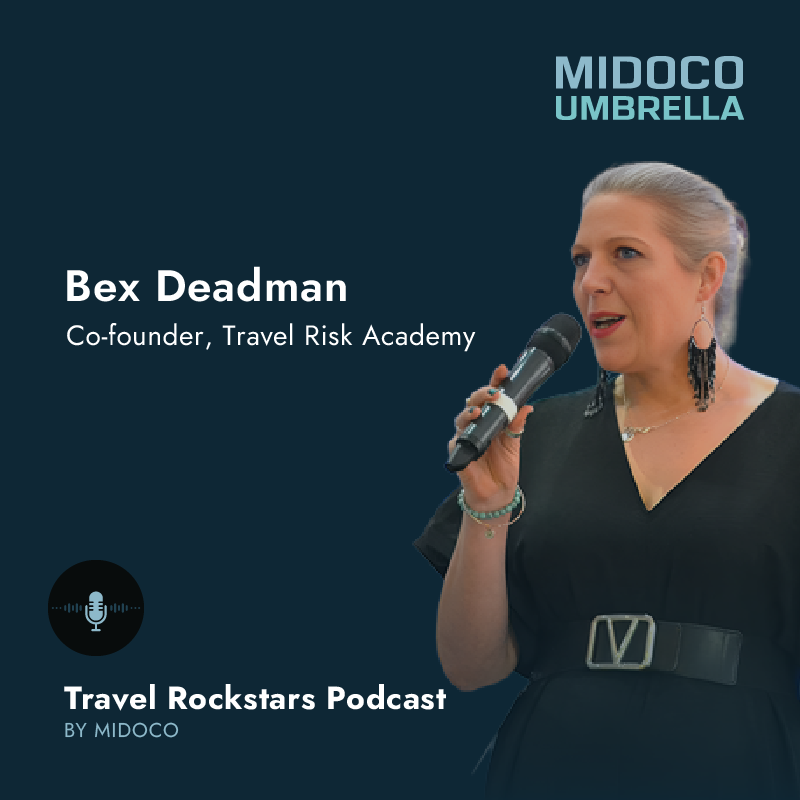
An interview with Bex Deadman, co-founder of the Travel Risk Academy and former MD of Blue Cube Travel, conducted by Magnus Kunhardt for the Business Travel Rockstars series by Midoco.
Bex Deadman started her working life behind a hotel bar in a small English market town, doing night shifts and occasionally checking in Hollywood actors. Nearly thirty years later she runs the Travel Risk Academy, built on a simple conviction: the travel industry spends almost all of its energy on the sale, and almost none on what happens when things go wrong. Between those two points sit a tour operator's crisis room on Boxing Day 2004, a boutique agency in Brighton, a "baptism of fire" into corporate travel at HRS, and years running a TMC. Here she talks about holistic travel risk management, agentic AI as both threat and opportunity, the World War II bomber story that explains everything wrong with travel data — and why the people we should be learning from are the ones who just walked in the door.
Let's start with something about you. How did you start your professional career and how did you get into the travel industry?
It's always been travel, interestingly. I started in hotels — my very first job was behind the bar at the Bush Hotel in Farnham, the town in England I come from. Night shifts on my own, waiting for everyone to pile back in when the pubs closed at eleven, then finishing at one or two in the morning. Hard work. But I was 19, it was a fun place, and there were woods nearby where a lot of big films were shot, so we had some pretty cool people staying. I met Joaquin Phoenix, and I once spoke to Ridley Scott on the phone. So I am a rock star after all — at least vicariously.
Then I went travelling, and when I came back I knew I wanted into the industry properly. I joined a tour operator called Explore, in reservations. I loved it — you had to really understand what the trips were about, and you were selling dreams. It was also, without me realising, my first excursion into risk management, because they were exceptionally good at crisis management: scenario planning and training every single year. I assumed all companies did that. It turns out they don't. They still don't.
After that came a boutique agency in Brighton's North Laine, where I first met the GDS and thought: what is this? Then Gettabed, Stuba, supplying hotel beds to the trade. Then HRS, then Blue Cube, and then what I'm doing today.
You were at Explore during the 2004 tsunami. What did that do to you?
That was the moment that cemented everything. I wasn't there — I want to be clear about that. We had over 56 trips and tours out across the locations the tsunami affected, and my job was to come into the office on Boxing Day, call the families of the people affected and keep them updated.
We didn't lose one customer. Everyone got to high ground, and that was down to how well the tour leaders had been trained. It had become second nature. Not "read these presentation slides and it'll all go in," which is mostly what we call training today — real training, repeated until you have muscle memory, so the decisions that keep you safe come naturally rather than you standing there not knowing what to do. It's like health and safety: we all know to avoid a slippery surface because somewhere in our minds we've been trained enough. We want the same for security when people are on the move.
But the other half of it was the human side — families, people at home, how we communicate. All the stuff that isn't high-end security or medical response: where does that sit? That's what I bring to the table now, and it's what I mean by holistic travel risk management. We only become products of what we know. My question was always "how do we look after everyone in this?" rather than "how do we get the job done?" Two genuinely different schools of thought.
You also switched from leisure to corporate travel. How was that?
A baptism of fire. I thought I knew travel really well, then I moved across and thought: what is this? Even the way we buy travel is different — in leisure you have ABTA, ATOL, bonding companies making sure people's money is safe. Business travel doesn't work like that at all. And then came the acronyms and the airport codes. I felt like a baby when I joined HRS.
HRS was a disruptive brand then, going up against the TMCs and the GDS, and we sold by educating the market. That taught me how the systems work, or ultimately don't, and why bookers go off programme. Those problems still exist today. Nothing's changed. What's more frightening is that the people in charge of these operations inside organisations have less knowledge than they ever did. I assumed they'd learn more over time. They've actually learned less.
All of that is what let me move into travel risk at the end of COVID, and it's why I keep encouraging travel managers to look at it. What you bring as a travel manager is a skill set the security teams simply don't have — they don't understand how travel works, and I mean that with the greatest respect. Get your head around travel, and travel risk becomes easier.
Is there something that particularly fascinates you about this industry?
The people. Travel represents so much — opportunity, dreams. Somebody might have saved their entire life savings for one particular trip. There's real emotion in it, and real devastation when something goes wrong, especially when it's in the industry's control.
And when those things happen, the industry rallies. I've never worked in an industry more welcoming or more friendly. I include travel risk in that, because the people in security and risk are our people — the ones lying awake at night worrying about where their travellers are. You see that nurturing side more in travel than anywhere else, and it's why I keep coming back.
What worries me is that the higher you go in the ranks, the more it becomes spreadsheets and profit and loss, and we forget we're a hospitality industry, supposed to be looking after people. We've talked about personalisation for years, and in the end it's a hotel putting out baby shampoo because they knew a young family was arriving — no budget, no gimmick, just somebody thinking about what you might need. I suspect a lot of front-line staff don't even have the autonomy to do that any more.
Who or what has inspired you, and continues to do so today?
One woman, throughout my entire career, and she'll blush at this: Carolyn Pearson, who runs Maiden Voyage. I met her about twenty years ago, and what amazed me was that she'd seen an issue and was simply going to do something about it — even coming from a completely different career. She's an incredible CTO too, which people don't always know about her.
She started out focused on female travellers, being one herself and travelling constantly as an exec in what was very much a man's world, and she's since taken that much wider. She trains, she speaks, she helps companies build this properly. She's one of the Travel Risk Academy mentors — one of our first, of course. And we still find it amazing how hard it is to get organisations to act. They know it happens, they know they need to protect people, and taking the actual steps is still taking companies far longer than it should.
In your opinion, what is the greatest achievement in travel technology since the turn of the millennium?
Three moments, and they're all the same shape: each one put more control into the traveller's hands. First the internet, which made travel available to everybody. Second, mobile — I listened to Martijn talk about this and thought, damn you, that's such a good answer, but I'm inclined to agree. Putting a phone into the traveller's hand changed everything, then changed it again. Third, agentic AI, which will change everything once more in ways we don't even know yet.
There's a lesson buried in the online booking tool era we still haven't learned. People had no idea what volume of content was sitting in the GDS once you opened it up without controls, or how much work agents were doing to reduce millions of options down to the three that would actually work for you. Everybody wanted content. We gave them content — we just didn't give them any controls around it, and we've been trying to add them back ever since. AI feels like the first technology that can genuinely do that, in a millisecond.
I'll be a bit controversial here, so apologies — this is probably why the travel industry wants to burn me at the stake. We haven't done enough to improve technology over the last 20, 25, 30 years. We really haven't, if we're honest. We're still reliant on legacy systems, and customers have had to build things on the outside to make it work. So in the age of agentic AI, is there a future where we control our own profiles, our agent books for us, and we hand the data to the company afterwards? That's game changing. I lived through the internet arriving — commissions gone overnight — and this will do the same. My question is how many companies are ready for the way we'll buy. It's not about "we've integrated AI." An agent doesn't engage the way a human does, so all the relationships and account management — does that just go?
What makes it exciting is that it comes down to ethics and good customer service, because the AI will know everything: complaints, delays, how many people were given the wrong room key. It makes us do better.
And where does travel data fit into all this?
Travel data is the most underused resource a company has, and nobody seems to know what to do with it.
There's a story about bombers coming back in the Second World War initially told by Abraham Wald. Engineers kept reinforcing the bullet holes in the planes that returned, and it wasn't working. Eventually they realised the planes that weren't coming back were being hit somewhere else entirely, and that's where the armour needed to go. That's exactly our problem. We spend all our time on the data we have — from the TMC, through invoicing, through assistance. What's missing? Which countries have we no visibility of? Which sectors? TMCs can't book everything, and we can't simply say you're not in our programme if you didn't book through them. There are loads of other ways to bring data in. It just has to be clean: rubbish in, rubbish out. Travel risk will find another way — from mobile, from masts — if travel's data is no good.
Then there's the silo problem. We work in departmental silos, so we talk to suppliers who build tech for those silos, and nobody looks across the whole organisation. I'd hazard a guess that your average customer working with insurance, assistance and a TMC has access to ten traveller-tracking tools they don't even know about. Why do we need ten? Because that bit's sexy — you get a nice map with everyone on it. It isn't what helps the client. What helps is how fast I can find my people in an emergency and how fast I can reach them. A business trip touches at least five industry sectors, none of which really understand each other. Isn't it time those partners got together and asked how to make this easier?
Do you have a favourite among the technologies developed for the travel industry?
Right now, yes: SureSIM. They've just partnered with the Travel Risk Academy, but that isn't why — when they first showed me what they'd built I said, I think you're solving one of the biggest gaps we have in travel risk management.
They come from global mobility and use the technology mobile phones use to help organisations locate their teams. What makes it clever is where it sits: more accurate than the passive data that comes from travel, but less intrusive than GPS, which people don't want to switch on — that's always been the barrier. It only ever knows the last mast you were near, so it isn't "they're sitting in that café doing something they shouldn't be." It gives companies exactly what they need in the moment: what's my exposure, where are my people, can I reach them.
People often ask whether AI threatens travel risk management jobs. It can't take away jobs that formally don't really exist yet — that's precisely why the qualifications exist and why we're professionalising this. When it counts, you need both: the intelligence and speed of AI, and at least one human. So while other companies shed departments, I still see a huge opportunity here. You don't need a team of 300. You need one person holding it together.
What would you recommend to newcomers to the industry in terms of technology?
Understand the whole landscape from start to finish, rather than believing there's only one way to do this. Educate yourself, because things are changing. And don't get too worried about the tech as it is today — think about what it looks like tomorrow, and look at other industries rather than trying to master where we are right now, because it's all going to shift in the next few years. The one constant is data quality. That has to get better.
Where do you see the biggest challenges for the industry, and how would you tackle them?
I'm not giving away all my trade secrets — but honestly, AI is the biggest challenge we currently face, and we should harness it, because it's also our biggest opportunity.
The next biggest is ourselves. How do we evolve an industry with an unquenchable appetite for travel, at a moment when the planet is hitting temperatures nobody thought we'd see? There have to be cultural shifts across all of this. You can see it in the new generation coming in — they think differently, and I'm grateful to them. May they keep pushing the change that needs to happen. But I don't think the old guard is ready, and the old, old guard still hasn't left.
I came into this industry thirty years ago thinking, what on earth is this? They must be coming into it now thinking exactly the same — they don't even understand this tech, and why would they? We should be learning from them, not the other way round. So engage with the young and what they're really thinking, rather than being scared of them. Always engage.
Quick-Fire Questions
| Sea or Mountain? | Sea — but only just; it's genuinely hard to choose. |
| Train or plane? | Train. |
| Tea or coffee? | Coffee. |
| Dog or cat? | I have both and they are watching me as we speak. |
| Remote or office or hybrid? | Remote. Love it. |
| Favourite movie? | "True Romance". I love that film! In the interview, I actually mentioned "Shopping", because I suddenly couldn't remember my actual favourite film. It's an offbeat film from the early 90s featuring a very young Jude Law, whom almost nobody knows. |
| Favourite song? | Also impossible — I'm eclectic and reckons my music taste deserves its own podcast. Under duress: "Gold Dust" by DJ Fresh featuring Ms. Dynamite, because it makes you want to dance. |
| Favourite Destination? | New Zealand or Canada, for the same reason: the space. |
|
You are a travel rock star yourself, which rock star would you like to meet?
|
Bob Dylan — he's all about lyrics and poetry. |
| Have you ever met a rockstar? | My mum was a midwife and delivered the baby of Morten Harket, lead singer of a-ha. The family got a Christmas card out of it. (Plenty of Hollywood actors and British celebrities from the hotel days, though). |
| What's next on your bucket list? |
Japan. "Everyone says Japan, don't they? |
Who do nominate to be the next Travel Rockstar?
Carolyn Pearson of Maiden Voyage