
Share this
by Magnus Kunhardt on Aug 21, 2026, 10:49:25 AM
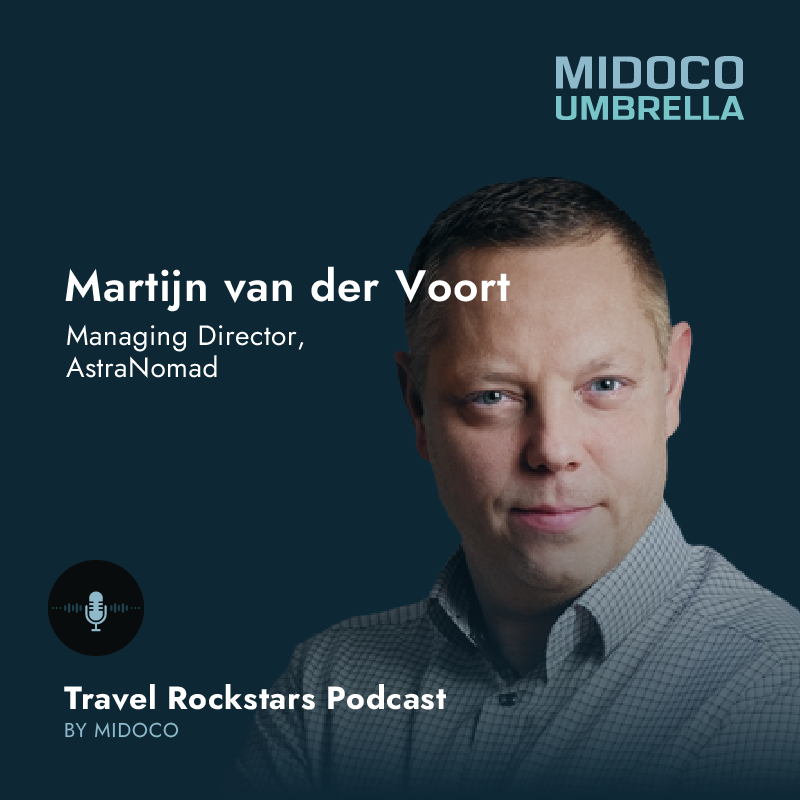
Travel Rockstar: Martijn van der Voort on Agentic AI, the Arrogance of Legacy Travel, and Why the People Are What Truly Drive This Industry
An interview with Martijn van der Voort, travel technology consultant, conducted by Magnus Kunhardt for the Travel Rockstar series.
Martijn van der Voort didn't set out to work in travel. At 30, broke and job-hunting in Liverpool after following his girlfriend across the North Sea, he answered a newspaper ad for a call centre run by an airline most people have never heard of. Nearly two decades and one pandemic later, he's a travel technology consultant known for saying what everyone else is thinking but won't say out loud — about legacy commercial models, agentic AI hype, and who really "owns" the customer. Here, he talks about learning the trade with paper tickets, the mentors who shaped him, leading a five-person team through the pandemic, and why the smartphone, not the GDS or NDC, is travel technology's greatest achievement since the millennium.
Let's start with something about you. How did you start your professional career and how did you get into the travel industry?
I got into travel late — I was 30, and it was pure chance. In January 2006 I moved from Leiden in the Netherlands to Liverpool, following my girlfriend. Work was hard to come by, so I applied for everything from night porter to hospital cleaner before spotting a local paper ad for a brand-new call centre. The airline was Malev Hungarian Airlines, long since gone, but it's where I learned the trade — reservations on Amadeus, manual fare calculations, printing tickets and walking them to the post office by 4pm.
From Malev I moved to Lufthansa as a customer feedback supervisor, then a friend told me about an opening on the online help desk at CWT — that's where my journey into travel technology really started, all from scratch and in a fairly short space of time.
Before travel, I was a professional glass cutter for a year, and before that I built exhibition stands at places like ITB Berlin. The lesson that carried over: whenever you jump into something new, listen, but identify the people who'll actually tell you the realities rather than sell you a story. There are plenty of false prophets out there, especially around agentic AI, who've never touched an academic paper on the subject — asking them where the industry is headed is a bit like asking the circus clown how to run a country.
Is there something that particularly fascinates you about this industry?
It's the people, with all their good and bad traits. There's incredible passion across this industry, and it takes a certain character to keep working in a business with so many moving parts and so much complex technology. I'm convinced that community is what truly drives travel — no technology will ever replace passion and care. What technology can do is empower, both the supply side and the customer.
The flip side is the status quo. Everything moves painfully slowly, and a lot of what gets called innovation is more marketing than reality — though there are genuinely talented people making a real difference, and slowly that status quo will get dismantled. I think it comes down to the fact that travel is a human emotion: it's not hard to explain why humans have an urge to travel, and with travelling comes real emotion — stress about running late, joy about seeing someone you love. If anything, most current technology only reliably triggers one emotion, and that's anger, because a lot of it is rough around the edges.
Who or what has inspired you, and continues to do so today?
Within travel there's a long list of people I respect enormously — too long to read out, and they know who they are. But my deepest inspiration comes from outside the industry. My parents, both now passed, are the biggest influence. My father had a successful career in the Dutch tax office, then went back to university later in life and became a high court judge for his final working years — that adaptability and drive is something I inherited. My mother lost her own mother young, cared for her family through her college years, and still built a good life for us despite the heartache. An extraordinarily resilient woman, and if we could distil what she had, we'd all be better for it.
The third is a man called Clarence Avant, known as "The Black Godfather" — there's a Netflix documentary about him I'd genuinely recommend. He quietly guided generations of musicians, entertainers and executives, even US presidents, without ever taking the stage himself. He did it because he had a purpose, and could connect dots nobody else saw.
What has been your favourite experience during your professional career to date?
"Favourite" isn't quite right — these are standout experiences, positive and negative. The heaviest by far was the pandemic. With budgets and manpower stripped back, my supervisor Yossi Hersko helped me step up to become Director of Global Product Delivery. Becoming director wasn't the favourite part — it was that, with a team of just five including me, we kept delivering through an incredibly difficult period, showing the real character of every person on that team. What made it possible was preparation: nobody predicted the pandemic, but you need a clear trajectory for your team, continuity planning, and real togetherness — regular check-ins, genuine interest in each other as people. I don't buy the argument that people need to be in an office for "team building." If you're a good manager, you can manage a team remotely.
One more genuine favourite: meeting Bex Deadman, founder of the Travel Risk Academy, at the Business Travel Show in London in mid-2024, just after I'd been made redundant. She lifted my spirits almost immediately, and we quickly agreed to work together — that's how I became a mentor with the Travel Risk Academy, a collective spanning technology, HR, telecoms and risk management, all pulling towards one goal: making travel safer for people. It isn't about managing "the travel risk" — it's about managing people who are at risk. A TMC isn't going to extract you from a power plant under attack from rebels.
In your opinion, what is the greatest achievement in travel technology since the turn of the millennium?
There's one thing that touches everything in the chain — inspiration, planning, booking, payment, navigation, translation, the airport, disruption. It has to be the smartphone. Nothing else reaches across the whole traveller journey the way a mobile phone does, and it's not going anywhere; we'll just use it differently through whichever apps come next. Something like Google Maps is really just sitting on top of the smartphone. It changed how we move and opened up an entirely new era of things to build for people.
Do you have a favourite among the technologies that have been developed for the travel industry?
I've been tinkering with this since 2017, when I proposed we build a chatbot at CWT. Right now it's agentic AI. It's not built specifically for travel, but it has the potential to change the industry for the better, for both supply side and traveller — commercial models, how we book, how we supply, all of it.
There's a certain arrogance baked into travel — especially among airlines, TMCs and OTAs — the sense that a company has a right to own the customer. That's going to change. Personal AI agents will interact with "nodes" — a GDS, a hotel, an airline, whatever it is — and my agent might book my business trip, order flowers for my wife, or push me a risk alert while I'm en route. I don't think true ownership of the customer will sit with one supplier ever again — it's entirely possible some kind of agent ID eventually replaces the email address.
Day to day I use a combination of several LLMs, since some are better at certain things than others, and I spend a lot of time reading and researching rather than watching Netflix — if you don't read widely and talk to people outside travel too, you'll never get a genuinely different view of where things are going.
What would you recommend to newcomers to the industry in terms of technology?
Build a strong and, above all, varied network. Surround yourself with people who can offer different perspectives — "newcomers" doesn't just mean Gen Z entering the workforce, it also means people arriving into travel from entirely different industries, which we're seeing more of. Keep a close eye on what's happening outside travel — logistics, fintech, marketing, aerospace, medical innovation, even politics — because a lot of real innovation lands in travel from somewhere else first. If you don't talk to people or read widely, you'll miss it. Sometimes it only takes one hint in an hour-long conversation to give you exactly the nudge you need.
Where do you currently see the biggest and most important challenges in the industry? Do you have any thoughts on how you would tackle them?
Two stand out for me. The first is legacy commercial models — this industry is a web where everyone is linked to everyone and everything. I wrote about it at length earlier this year in an article called "The Trojan Horse in Travel." Within that sits a specific gap: agentic AI pilots versus real production. Many companies have moved past generative AI experiments into agentic systems that can reason, plan and act — but most get stuck because they're automating an already broken process, which creates reliability issues, governance gaps and integration failures. The fix is to redesign the workflow itself for human-and-agent teams, not bolt AI onto legacy processes. I often tell corporate travel buyers: forget what you have today, assume money isn't the constraint, and write down what you actually want to achieve. Beyond that, you need a governance baseline with a named owner for every initiative, and real investment in data quality.
The second is workforce shortages and a widening skills mismatch, partly driven by demographics. Right now retention matters more than recruitment: you need to upskill people at scale — AI literacy, agent supervision, data-driven decision-making — and manage by outcomes rather than hours worked. Redesign the roles, don't just replace the people. It's a bit ironic that some large players are cutting workforce while declaring they're "doing agentic AI," when they're nowhere near ready — often driven by short-term board pressure rather than proper planning. Same game everywhere, unfortunately.
Quick-Fire Questions
| Sea or Mountain? | Neither — city. |
| Train or plane? | Plane, obviously. Anyone who's dealt with UK rail picks plane every time. |
| Tea or coffee? | Neither — just a simple glass of water. |
| Dog or cat? | 100% dog. I have a hairless Chinese Crested rescue who lost his back leg as a tiny puppy and is still going strong at 14. |
| Remote or office or hybrid? | Remote. The moment you're in an office you get pulled left, right and centre and never get meaningful work done. |
| Favourite movie? | Total Recall (1990, the Schwarzenegger original) — a sci-fi masterpiece that's now mostly science, not fiction: video calls, touch screens, driverless cars, holograms. Watched roughly 50 times, most recently last week. |
| Favourite song? | Impossible to pick — I collected vinyl (17,000 records at one point) and occasionally DJs. Depends entirely on my mood. |
| Favourite Destination | Luxor, Egypt, for the weight of history. The plan is to retire to a small village nearby and disappear from the industry entirely — mobile phone and LinkedIn included. |
|
You are a travel rock star yourself, which rock star would you like to meet?
|
Sheila E. — Prince's drummer and percussionist, a genuinely gifted musician and a real role model rather than an influencer. |
| Have you ever met a rockstar? | Yes — nearly every week. We're friends with the UK band The Coral, who all live a few streets away. |
| What's next on your bucket list? |
Luxor |
Who do nominate to be the next Travel Rockstar?
Bex Deadman, founder of the Travel Risk Academy — for the work she does, and just as much for who she is.